Pharaoh's chariots found in Red Sea?
'Physical evidence' of ancient Exodus
prompting new look at Old Testament
--------------------------------------------------------------------------------
Posted: June 21, 2003
1:00 am Eastern
By Joe Kovacs
© 2009 WorldNetDaily.com
"And Moses stretched out his hand over the sea; and the LORD caused the sea to go back by a strong east wind all that night, and made the sea dry land, and the waters were divided." (Exodus 14:21)
One of the most famous stories of the Bible is God's parting of the Red Sea to save the Israelites from the Egyptian army and the subsequent drowning of soldiers and horses in hot pursuit.
But is there evidence that such an event did in fact happen – and if so, precisely where did it take place?
The issue is surfacing some 3,500 years after the event is said to have taken place with reports of Egyptian chariot wheels found in the Red Sea, photographs to document it and new books by scientists that could lead to a whole remapping of the Exodus route and a fresh look at ancient biblical accounts.
Wheel of fortune
Is this a chariot wheel that chased Moses?
"I am 99.9 percent sure I picked up a chariot wheel," Peter Elmer tells WorldNetDaily after two diving trips to the Gulf of Aqaba branch of the sea. "It was covered in coral."
The 38-year-old forklift mechanic from Keynsham, England, traveled to the region with his brother, Mark, after being inspired by videos of explorers Ron Wyatt and Jonathan Gray, who have documented artifacts that in at least one case authorities have confirmed to be a chariot wheel dating to the time of the Exodus.
"I believe I actually sat in an ancient chariot cab," Elmer said, referring to his time exploring a submerged item in what he describes as an underwater scrapyard. "Without question, it is most definitely the remains of the Egyptian army."
But despite all of Elmer's excitement, others who have been to the same location are not so sure what is being viewed underwater are the remnants of the great chase and urge extreme caution regarding the unsubstantiated claims.
"All kinds of people are finding coral and calling it chariot parts," says Richard Rives, president of Wyatt Archaeological Research in Tennessee. "It's most likely coral covered with coral. ... Opportunists are combining false things with the true things that are found. These people are making it up as they go to be TV stars."
Rives was a longtime partner of Ron Wyatt, an anesthetist and amateur archaeologist who died of cancer in 1999. Before passing away, Wyatt devoted years searching for and documenting physical evidence for events mentioned in the Bible. In addition to chariot wheels, Wyatt claimed to have found Noah's Ark on the mountain next to Ararat in Turkey, the "true" Mount Sinai in Saudi Arabia and the Ark of the Covenant with the Ten Commandments near the site of Jesus Christ's crucifixion.
Submerged 'land bridge' (wyattmuseum.com)
Among those who accompanied Wyatt on many of his excursions is his wife, Mary Nell. She's concerned about over-exuberance regarding new claims, but the Spring Hill, Tenn., woman tells WorldNetDaily she's "convinced" there are chariot parts located on a subsurface "land bridge" connecting Egypt to Saudi Arabia through the Gulf of Aqaba.
She cites Ron's discovery of a wheel hub that he brought to the surface in the late 1970s as proof.
The hub had the remains of eight spokes radiating outward and was examined by Nassif Mohammed Hassan, director of Antiquities in Cairo. Hassan declared it to be from the 18th Dynasty of ancient Egypt, explaining the eight-spoked wheel was used only during that dynasty around 1400 B.C.
Curiously, no one can account for the precise whereabouts of that eight-spoked wheel today, though Hassan is on videotape stating his conclusion regarding authenticity.
When Mary Nell went diving with Ron, she says it was very easy to assume (wrongly) that every item on the flat bottom had historical significance.
"[At first] I thought everything was a chariot wheel!" Mrs. Wyatt exclaimed, noting how difficult it is for the untrained eye to distinguish an artifact from a piece of coral. "I'm just trying to be cautious about over-identifying too much. ... It is God's truth, and we can't hype it up. We can't add to it."
However, she notes a big problem for explorers and scientists is that the Egyptian government no longer allows items to be removed from the protected region. Thus, someone claiming to find an artifact will have a hard – if not impossible – time verifying its authenticity, a classic catch-22.
The watery grave
"And the waters returned, and covered the chariots, and the horsemen, and all the host of Pharaoh that came into the sea after them; there remained not so much as one of them." (Exodus 14:28)
The Bible account makes it clear that once the Israelites had marched through the parted sea on dry ground, that the waters rushed back to completely engulf the doomed army of ancient Egypt.
With that in mind, many of the items being seen in the Gulf of Aqaba have been photographed by divers for comparison to the Exodus story.
Many other photographs show formations in a circular pattern with projections that could be spokes, but those items remain at the bottom and have not been authenticated.
Another issue is the route of the Exodus, and which body of water the Israelites crossed. Many travel maps and Bibles indicate a crossing point in the Gulf of Suez, the western branch of the Red Sea. But those may have to be updated if the Aqaba location is confirmed as the true location for the miraculous event.
"The truth is, no one really knows where the crossing of the Red Sea took place," says Carl Rasmussen, a biblical geographer and professor of Old Testament at Bethel College in St. Paul, Minn.
Rasmussen compiled the "Zondervan NIV Atlas of the Bible" and personally thinks the crossing took place somewhere along what is now the Suez Canal.
Yellow highlights possible spot of Mount Sinai in Saudi Arabia. Gulf of Aqaba branch of Red Sea is at center, with main Red Sea at bottom-right of photo (wyattmuseum.com)
Some scientists from Europe say the current maps are wrong, and the Wyatts are right – that the crossing began at the Nuweiba beachhead, went through the Gulf of Aqaba, and then into what is now Saudi Arabia where they claim the "true" Mount Sinai is located.
For years, scholars have speculated as to the location of the actual Mount Sinai where Moses received the Ten Commandments from God. At least 13 sites have actually been claimed on the Sinai peninsula as being the correct spot.
But Ron Wyatt believed it was in Arabia, even referenced as "mount Sinai in Arabia" by the Apostle Paul in Galatians 4:25.
So he and his sons made their way to "Jebel a Lawz," the mountain of the Law, which is known by the locals as "Jebel Musa" – Moses' mountain.
Unfortunately for the Wyatts, they were arrested and held in prison. His wife says someone had phoned embassy authorities for the Muslim country, claiming that Ron was spying for Israel. They were released after spending 78 days behind bars.
Rasmussen doesn't agree with the Arabian Mount Sinai theory.
"I believe the strongest candidate is Jebel Sin Bisher," he told WorldNetDaily. "The sites in Saudi Arabia have very, very weak scriptural backing, in spite of the hype."
Now, a new book by Cambridge University physicist Colin Humphreys titled "The Miracles of Exodus" supports not only the claim for an Aqaba crossing, but also the location of Mount Sinai in Arabia.
"If my book is correct, and I believe the evidence is very strong," says Humphreys, "then world maps will need to be redrawn to relocate Mount Sinai. History books, travel guides and biblical commentaries will need to be rewritten."
Throughout his work, Humphreys provides scientific explanations to corroborate the accounts of the Old Testament.
"'The waters piled up, the surging waters stood firm like a wall,' is a remarkable description of what the mathematics reveals to be the case for water pushed back by a very strong wind," he writes.
"What I have found is that the events of the Exodus are even more dramatic than is generally believed," Humphreys said. "The Exodus of the ancient Israelites from Egypt really is one of the greatest true stories ever told."
A Swedish scientist who believes the Red Sea was split says while Humphreys is correct about the Aqaba crossing, there are no natural, scientific explanations for the parting miracle described in Scripture.
Walls of water as depicted in 'The Ten Commandments' (Paramount Pictures)
"The wind did not separate the water," says Lennart Moller of the Karolinska Institute in Stockholm. "No person could be in that wind and survive. ... If God has created all the Earth, it's no problem for Him to separate the water for a while."
Speaking to WorldNetDaily from the isle of Gotland in the Baltic Sea, Moller, the author of "The Exodus Case," says the key in finding the correct route of the Israelites is to understand that the Hebrew reference to "yum suph" does not mean "sea of reeds" as many scholars have claimed.
Moller says it refers specifically to the Gulf of Aqaba, and while he's not formally affiliated with the Wyatts, he agrees with them that a host of other evidence can be found on the Arabian side of the water, including remains of the golden calf, pillars, altars and the even the rock the Bible says Moses split to bring forth water for the Israelites.
Regarding the items found beneath the waters, Moller believes there are remnants not only of chariots and wheels, but also human and animal skeletons.
"There was a disaster [there] a long time ago," he said. "Whatever that is, it's open to interpretation."
He also notes that the downward and upward slope of the Aqaba crossing path actually falls within current U.S. standards for handicapped ramps.
And while Mary Nell Wyatt warns overstating the claims by divers and authors could do more harm than good, she does believe there's a reason why her husband was led to discover what Ron called "God's attention-getters."
"God preserved all these evidences," she said, "[otherwise] there would have been nothing left. ... God has been lost today. Even Christians still can't believe this all happened. ... We need to pray for the Lord to help us get people to see it."
Back in England, Peter Elmer says people have mockingly asked "Why should a forklift mechanic from Keynsham be able to go to the same place Moses was?"
He takes the criticism in stride, pointing out "Jesus used fishermen, tax collectors and publicans. Why not a forklift mechanic?"
Egyptian Chariot Wheels Found at the Bottom of the Red Sea-Unproven!
Summary of the eRumor:
This one includes pictures of what are said to be chariot wheels that were discovered on the floor of the Red Sea, confirmation of the Biblical account of Pharaoh's army being drowned while pursuing the Hebrews. The Biblical account says that God parted the waters to allow an escape for the Hebrews then the waters came back together when the Egyptian army tried to follow. The eRumor also says that chariots, human bones, and horse bones have been found in an area in the Gulf of Aqaba.
The Truth:
Much of this eRumor is based on the findings of Ron Wyatt, a colorful and controversial amateur archeologist who claimed to have found Noah's ark, the Biblical Ark of the Covenant, the location of Sodom And Gomorrah, the Tower of Babel, the true site of Mt. Sinai, the true site of the crucifixion of Jesus, and the original stones of the Ten Commandments. He was a passionate and sincere man, according to his supporters, but his critics abound and scientists and archeologists regarded him as an untrained maverick at best and there are some who regarded his as a fraud. Wyatt died from cancer in 1999.
Wyatt's interest in the crossing of the Red Sea by the Hebrews became focused on the site of Nuweiba in Egypt because it seemed to fit some of the description of Biblical and historical accounts of the geography. It was while diving along the beach at Nuweiba that he found what he said were chariot parts.
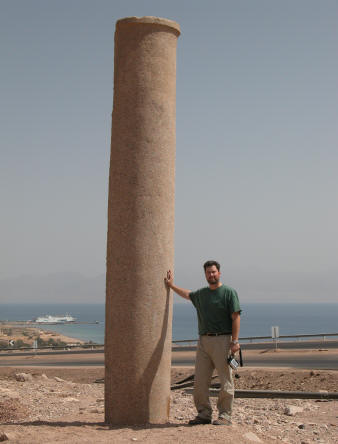
During his first visit to Nuweiba in 1978 he found a large column lying on the beach that looked like an ancient artifact. Later he found that it had been set up by Egyptian authorities in concrete for display. He believed it to be a marker set up by King Solomon to note the crossing of the Red Sea.
It was on that same trip in 1978 that Wyatt found what he said were the remains of chariots and chariot wheels at the bottom of the sea. They were heavily covered with coral. Wyatt claimed to have retrieved one of the wheels and said an Egyptian authority declared that it was from the 18th dynasty of Ancient Egypt, but nobody seems to know where that chariot wheel is is now located.
Regarding the human bones found at the site, TruthOrFiction.com talked with Aaron Sen, one of those who has traveled to Nuweiba and who found the bones. He said the bones were authenticated as human at Stockholm University are are in the possession of professor Lennart Moller who was at Stockholm University in the late 1990s.
It was also discovered that there seems to be an underwater "bridge" of sea bed that is shallower than the depths on either side of it and that crosses from one side of the sea to the other. Wyatt said that could have been where the waters parted and made the way for the Hebrews to cross.
Wyatt's focus on Nuweiba and his claims of finding chariot remains on the floor of the sea have brought other adventurers to the site but even Wyatt's supporters urge caution about their enthusiastic findings. Richard Rives, the president of Wyatt Archeological Research in Tennessee, told journalist Joe Kovacs, "All kinds of people are finding coral and calling it chariot parts." Wyatt's wife, Mary Nell, told Kovacs the same. She went diving with Wyatt at the Red Sea site and said that at first she thought everything was a chariot wheel.
The bottom line is that at this point all that seems to exist to support the claims of chariot parts on the bottom of the red sea are pictures, most of which are of coral formations. No documented artifacts have been retrieved and preserved from the site and now the Egyptian government prohibits bringing any findings to the surface to the questions may remain for a long time to come.
updated 02/3308
Ancient Egyptian Chariots Found In Red Sea
Click for Google language translations of this webpage.
 |  |
Gilded and coral encrusted Egyptian chariot wheels found in Gulf of Aqaba at Nuweiba, Sinai Peninsula
An Introduction
"And Moses stretched out his hand over the sea; and the LORD caused the sea to go back by a strong east wind all that night, and made the sea dry land, and the waters were divided." (Exodus 14:21)
The Hebrew Exodus from Egypt is in scope the most miraculous event ever to be recorded by man. It's historicity though has been challenged and reduced to mere mythology by many religious theologians and biblical archaeologists until recently. In 1978 Ron Wyatt, a biblical archaeologist without formal training, confounded the opponents of biblical historical accuracy by discovering the true "Exodus Red Sea Crossing" in the Gulf of Aqaba (Red Sea) at Nuweiba, Sinai Peninsula.
The authenticity of Wyatt's claim has been validated with the discovery of the remains of ancient Egyptian army chariots lying at the bottom of an underwater land bridge connecting Sinai to Saudi Arabia. Many coral encrusted chariot wheels, and a gilded four spoked chariot wheel were found. Fossilized human and horse bones were also recovered, but carbon dating was not possible.
The Hebrew name given to the Red Sea crossing site was Pi-hahiroth (Hebrew: פִּי הַחִירֹת). The Hebrew name "Pi-hahiroth" has been translated as "mouth of the gorges," descriptive of its location, where the mouths of two rivers (wadis) combine at the point of entry into the sea. The Nuweiba peninsula fits this description exactly. The historical significance of the Nuweiba site as the site of the Exodus crossing was also known in ancient times. This fact is attested to by the discovery of "commemorative inscriptions erected by King Solomon" on both the Sinai and Saudi Arabian sides of the crossing.
In 2000 Dr. Lennart Moller, a research scientist from Sweden, headed an expedition that retraced the footsteps of Wyatt. Soon after the expedition, it's Swedish backers produced an excellent documentary video and book supporting Wyatt's claims as well as adding extensively to the archaeological documentation. Archaeological research is ongoing, with a new documentary due in 2008.
While some archaeologists consider Ron Wyatt's accomplishments to be nothing but fraud and sensationalism, many have examined the evidence and perceive the truth beyond the personalities and politics of the profession.
 |  | |
Nuweiba Beach, Sinai Peninsula | Underwater land bridge at Nuweiba, Sinai Peninsula |
Documentation of Ron Wyatt's Discovery
Wyatt created a video documentary of his expeditions to Sinai and Saudi Arabia in search of the historical Red Sea Crossing and Mt Sinai. This video is now posted on You-Tube. See below:
Ron Wyatt's Discovering the Exodus (Video documenting Israel's path thru the Sinai to Nuweiba)
Ron Wyatt's Discovering the Exodus (Video documenting discovery of true Mt Sinai at Jebel el Lawz)
The Red Sea Crossing found, by "Wyatt Archaeological Research"
Significance of wheels found in Red Sea, by Wyatt Archaeological Research
Documentation of Dr. Lennart Moller's Expedition
Video commentaries from Dr. Lennart Moller's documentary film "Search For The Red Sea Crossing" provides some answers to the mystery of the Exodus and Red Sea Crossing. Click topics below to view:
How was the sea of the Exodus crossing lost in history (by Dr Glen Fritz)?
What clues determine the route of the Exodus (by Dr Glen Fritz)?
Excerpts from Dr. Moller's "Search For The Red Sea Crossing" video were formerly found on "You-Tube". Both book and video documenting Dr. Moller's expedition can be purchased thru Amazon.com (see below):
The Discovery of the true Mt. Sinai
Wyatt also theorized from the Biblical account that the true site of Mt. Sinai (Mt Horeb) and Israel's encampment must be near the "Red Sea Crossing" in the surrounding mountains of Midian in Saudi Arabia. His theory brought him to Jebel el Lawz, a mountain long known by its residents to be the site of Gods presence and Israel's encampment. Thus far the evidence at Jebel el Lawz fits the biblical description perfectly.
Mt Sinai in Arabia Discovery Website (Wyatt Archaeological Research)
The Messianic Literary Corner's "The Real Mt. Sinai Found in Saudi Arabia"
This study is linked to various authoritative websites. These findings will surely have far reaching effects on Judaic, Christian and Islamic perspectives in the future.
Reference Links
The Pharaoh's chariots found in Red Sea, by "World Net Daily"
Sinai inscriptions found at site of Red Sea chariot remains, by "Bible Probe"
Geography of Gulf of Aqaba and Exodus site, by "Traditions Renewed"
Chariot Wheels found at the bottom of the Red Sea
1. Chariot Wheels found at the bottom of the Red Sea
you will be surprised to see proof of Pharaoh's chariot and bones of horses and men found in the Red Sea Evidence of the crossing of the Red Sea : Pharaoh's drowned army
Confirmation of the actual Exodus route has come from divers finding coral-encrusted bones and chariot remains in the Gulf of Aqaba.
ONE of the most dramatic records of Divine intervention in history is the account of the Hebrews' exodus from Egypt.
The subsequent drowning of the entire Egyptian army in the Red Seawas not an insignificant event, and confirmation of this event is compelling evidence that the Biblical narrative is truly authentic. Over the years, many divers have searched the Gulf of Suezin vain for artifacts to verify the Biblical account. But carefully flowing the Biblical and historical records of the Exodus brings you to Nuweiba, a large beach in the Gulf of Aqaba , as Ron Wyatt discovered in 1978.
Repeated dives in depths ranging from 60 to 200 feet deep (18m to 60m), over a stretch of almost 2.5 km, has shown that the chariot parts are scattered across the sea bed. Artifacts
found include wheels, chariot bodies, as well as human and horse bones. Divers have located wreckage on the Saudi coastline opposite Nuweiba as well.
Since 1987, Ron Wyatt found three four-spoke gilded chariot wheels. Coral does not grow on gold, hence the shape has remained very distinct, although the wood inside the gold veneer has disintegrated making them too fragile to move.
Chariot Wheels found at the bottom of the Red Sea
1. Chariot Wheels found at the bottom of the Red Sea
you will be surprised to see proof of Pharaoh's chariot and bones of horses and men found in the Red Sea Evidence of the crossing of the Red Sea : Pharaoh's drowned army
Confirmation of the actual Exodus route has come from divers finding coral-encrusted bones and chariot remains in the Gulf of Aqaba.
ONE of the most dramatic records of Divine intervention in history is the account of the Hebrews' exodus from Egypt.
The subsequent drowning of the entire Egyptian army in the Red Seawas not an insignificant event, and confirmation of this event is compelling evidence that the Biblical narrative is truly authentic. Over the years, many divers have searched the Gulf of Suezin vain for artifacts to verify the Biblical account. But carefully flowing the Biblical and historical records of the Exodus brings you to Nuweiba, a large beach in the Gulf of Aqaba , as Ron Wyatt discovered in 1978.
Repeated dives in depths ranging from 60 to 200 feet deep (18m to 60m), over a stretch of almost 2.5 km, has shown that the chariot parts are scattered across the sea bed. Artifacts
found include wheels, chariot bodies, as well as human and horse bones. Divers have located wreckage on the Saudi coastline opposite Nuweiba as well.
Since 1987, Ron Wyatt found three four-spoke gilded chariot wheels. Coral does not grow on gold, hence the shape has remained very distinct, although the wood inside the gold veneer has disintegrated making them too fragile to move.
The hope for future expeditions is to explore the deeper waters with remote cameras or mini-subs. (ABOVE GILDED CHARIOT WHEEL - Mute witness to the miracle of the crossing of the Red Seaby the Hebrews 3,500 years ago. Found with a metal detector.
Coral-encrusted chariot wheel, filmed off the Saudi coastline, matches chariot wheels found in Tutankhamen's tomb.
Mineralized bone, one of many found at the crossing site (above center). This one tested by the Department of Osteology at StockholmUniversity, was found to be a human femur, from the right leg of a 165-170cm tall man.
It is essentially 'fossilized, ' i.e., replace byminerals and coral, hence cannot be dated by radiocarbon methods, although this specimen was obviously from antiquity. Chariot wheel and axle covered with coral and up-ended. Exodus 14:25"And took off their chariot wheels, that they drave them heavily..."
Solomon's memorial pillars
When Ron Wyatt first visited Nuweiba in 1978, he found a Phoenician style column lying in the water. Unfortunately the inscriptions had been eroded away, hence the column's importance was not understood until 1984 when a second granite column was found on the Saudi coastline opposite -- identical to the first, except on this one the inscription was still
intact!
In Phoenician letters (Archaic Hebrew), it contained the words: Mizraim (Egypt); Solomon; Edom; death; Pharaoh; Moses; and Yahweh, indicating that King Solomon had set up these columns as a memorial to te miacle of the crossing of the sea. Saudi Arabia does not admit tourists, and perhaps fearing unauthorized visitors, the Saudi Authorities have since removed this column, and replaced it with a flag marker where it once stood.
How deep is the water?
The Gulf of Aqabais very deep, in places over a mile (1,600m) deep. Even with the sea dried up, walking across would be difficult due to the steep grade down the sides. But there is one spot where if the water were removed, it would be an easy descent for people and animals. This is the line between Nuweiba and the opposite shore in Saudi Arabia .
Depth-sounding expeditions have revealed a smooth, gentle slope descending from Nuweiba out into the Gulf. This shows up almost like a pathway on depth-recording equipment, confirming it's Biblical description, "...a way in the sea, and a path in the mighty waters." (Isaiah 43:16)
The Bible writers frequently refer to the miracle of the Red Sea crossing, for it was an event which finds no equal in history. The Hebrew prophets describe the sea at the crossing site as "...the waters of the great deep...the depths of the sea..." (Isaiah 51:10)
Knowing the exact spot to which the Bible writers were referring, what is the depth there? The distance between Nuweiba and where artifacts have been found on Saudi coast is about 18km (11 miles).
Along this line, the deepest point is about 800m (2,600 feet). No wonder that Inspired writers of the Bible described it as the mighty waters. And no wonder that not a single Egyptian survived when the water collapsed in upon them. ( A bove right NUWEIBABEACH- the spot where the crossing began)
The Red Sea Crossing Site Found by Ron Wyatt
The children of Israel lived in the Nile delta area or the land of Rameses, and first encamped at the northern end of the Gulf of Suez or Succoth at the beginning of the Exodus. This was the first point where they went into the camping mode. Then they traveled through the wilderness of the Red Sea, or what we
call today the Sinai Peninsula, and encountered the Gulf of Aqaba. (I Kings 9:26 calls this the Red Sea.)
The Wilderness Has Them Entangled
Wadi Watir had the Children of Israel "entangled." Exit point at the large beach at Nuweiba (2005)
When traveling through "the wilderness of the Red Sea" Ex.13:18, escaping Pharaoh's army, God told Moses to turn south, so they headed through a wadi or canyon area that is called the Wadi Watir which led to the sea. The Bible in Ex. 14:3 says, "They are entangled in the land, the wilderness hath shut them in."
The Beach Where the Crossing Took Place
When arriving at the beach, the children of Israel felt trapped, as they could not turn back, nor head north because at the northern end of the beach was a three story, Egyptian military fortress which is still standing today undergoing restoration.
Additionally there were mountains obstructing their escape. To the south the mountains came down to the sea, as mentioned by Josephus, "For there was [on each side] a [ridge of] mountains that terminated at the sea, which were impassable by reason of their roughness, and obstructed their flight" Antiquities of the Jews, Bk. 2, 15-3. You can see the mountains at the beach today. The people were about to turn against Moses because he had led them to an area where they were trapped and would surely die, or so they thought.
If one looks on a map for a beach area large enough for 2 million people to encamp on the gulf there is only one candidate: Nuweiba Egypt. The beach at Nuweiba is extremely large and could have accommodated a large number of people at the time of Moses. Pi-Hahiroth means, mouth of the hole, which we would apply to the mouth of the canyon above, as mentioned in The Exodus Revealed DVD. Migdol is a fortress, which we would apply to the ancient fort which is located at the narrowest point on the beach where the gulf and the mountains are in close proximity. Today you will find many hotels there and a village.
The Granite Column of Solomon
This column matches one on the other side of the gulf in Saudi Arabia which had the inscriptions intact. The Hebrew words Mizram (Egypt), death, water, pharaoh, Edom, Yahweh, and Solomon were on that column. Apparently one can conclude
King Solomon had these columns erected 400 years after the miracle of the crossing of the Red Sea on dry land. Solomon's sea port was at the northern tip of the Gulf of Aqaba at Eilat (I Kings 9:26) and he was very familiar with the Red Sea crossing site, as it was in his neighborhood. The Bible even mentions this column! Isaiah 19:19, "In that day there will be an altar to the Lord in the midst of the land of Egypt, and a pillar to the Lord at its border." You can visit the beach today and see the column in person, as I was able to do in Oct. 2005.
"Waters of Moses Opening"
This is amazing, at the exact spot where the crossing took place, we have
the site confirmed by maps!
God caused a strong east wind to blow the waters back so the people could walk ten miles through the Red Sea to safety in Arabia. The crossing path is about a quarter to a half mile wide and is on a gradual slope down to the bottom of the Red Sea and then up to the Saudi beach. On either side of this path are the depths of the Red Sea, the Eilat Deep and the Aragonese Deep, each 3000 and 5000 feet deep respectively.
A gilded chariot wheel remains on the sea floor. It was found by Ron Wyatt using a molecular frequency generator from his boat, after he set the equipment to search for gold. The Bible said all the chariots of Egypt and 600 choice chariots, or gold veneered models, were in the army pursuing God's people. It is speculated there were 20,000 chariots destroyed that day. Four, six and eight spoke wheels are found here in the gulf, and were only used at the same time during the 18th dynasty or 1446 BC when the exodus took place.
There are numerous chariot wheels, plus human and horse bones at the crossing site. Above on right, is a human femur bone that is covered by coral, and was tested at Stockholm University. It is from the right leg of a man 165-170cm tall. It is basically mineralized by resting in the Red Sea for such a long time.
A coral covered chariot wheel on a vertical axel is buried in the sand. Although this is atypical, a diver found this within 10 minutes of searching at Nuweiba
A horse's hoof is shrunken since drying out. Horses are not found in the
Sinai Peninsula today.
Documentary coming out in 2010 on this discovery and
the real Mt. Sinai! Multi-million dollar production
See www.exodusconspiracy.com
View their video library!
Ron Wyatt's Research on the Exodus to the Red Sea
See photos on these links: http://www.arkdiscovery.com/red_sea_crossing.htm
http://www.throneofgod.com/RedSea/redsea.html
http://www.bereanpublishers.com/Apologetics/parting_of_the_red_sea.htm


No comments:
Post a Comment